
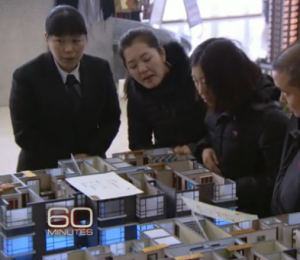
 The China housing bubble that we have been hearing whispers of for the past couple of years is showing signs of speed wobbles. In this 60 Minutes report, Lesley Stahl reports on how there are now entire cities being created all over China with no one living in them.
The emerging chinese middle class are unable to invest outside of China due to Government restrictions. The bank returns are very low and their share market is a risky. Due to the lack of options, the Chinese Government allowed people to buy their own homes. The middle class have invested massively in property and now estimates suggest that property invest accounts for as much as 20-30% of the economy. As many as 24 new cities are being built every year! The Government has allowed this expansion to continue to keep the economy growing but the level of infrastructure development is far ahead of the demand for property.
The problem is that the middle class investors have artificially pushed up the price of property to the point where an apartment might cost US$50k-100k. Most people in China live on less than US$2 a day, so have no hope of ever being able to afford one of the millions of empty apartments that are lying empty.
Regardless, the low-income villagers continue to be moved on to make way for new developments that will most likely be vacant for years.
If (or when) the bubble does burst, there will be massive losses across many different sectors. Generations of savings are tied up in these investments and there are an estimated 50 million workers supported by the building industry.
An apartment in Shanghai can cost 45 times the average residents annual income. These kind of prices are simply not sustainable. The Chinese Government has tried to quell property speculation. Since 2011, there has been a one apartment policy to restrict the growth of the property market. However, this has caused other problems. Developers are in debt, prices plunged and now there are partially developed cities across China.
This instability and consequent financial stress has already lead to social unrest. There have been demonstrations against developers by both the investors and the displaced villagers.
Zhang Xin, a billionaire property developer who focuses only on commercial developments says that residential property investment is coming to an end.
However, the China housing bubble continues to grow. Investors are getting around the one apartment policy by buying in different cities. There are bus tours of potential developments filled with excited investors wanting to get in before it’s “too late”.
